Which Rolling Machine Makes Perfect Sheets? A Practical Guide for Indian Jewellery Manufacturers
If you’ve spent even a few years on a jewellery factory floor, you know the difference between a good rolling machine and a mediocre one shows up in every single sheet that comes off it — thickness variation, surface finish, and how much metal you waste in the process. In fact, getting this right isn’t just a technical preference; it directly affects your production cost, your finishing time, and ultimately your margins. That’s why, for jewellery making machine manufacturers and workshop owners across India, choosing the right rolling machine is one of those decisions that quietly determines whether your daily output is smooth or a constant headache.
So, this article breaks down what actually makes a rolling machine deliver perfect, uniform sheets — roll pressure control, motor consistency, roll surface hardness, and calibration. Additionally, it covers how H.K Malvi Industries approaches this after decades of building machinery for goldsmiths, jewellery brands, and minting operations.
Why Choose H.K Malvi Industries for Gold Rolling Machines
H.K Malvi Industries was established in 1968, which means the company has been building jewellery machinery for over five decades. It was founded by Mr. Himmatram K. Malvi and is currently led by Mr. Shyam Malvi as CEO. Over the years, the team has worked on more than 1,000 custom jewellery and minting machinery solutions, and exports to over 20 countries.
The best rolling machines aren’t built on guesswork — they’re built on iteration. A manufacturer that has adjusted roll designs based on real feedback from goldsmiths in Surat, Mumbai, Jaipur, and Ahmedabad understands things a catalogue spec sheet won’t tell you: how humidity affects roll lubrication, why certain karat purities behave differently under pressure, and where operators typically make calibration mistakes. That kind of hands-on knowledge is what separates a machine that “works” from one that consistently gives you sheet thickness within a few microns of tolerance.
Our Rolling Machine Manufacturing Capabilities
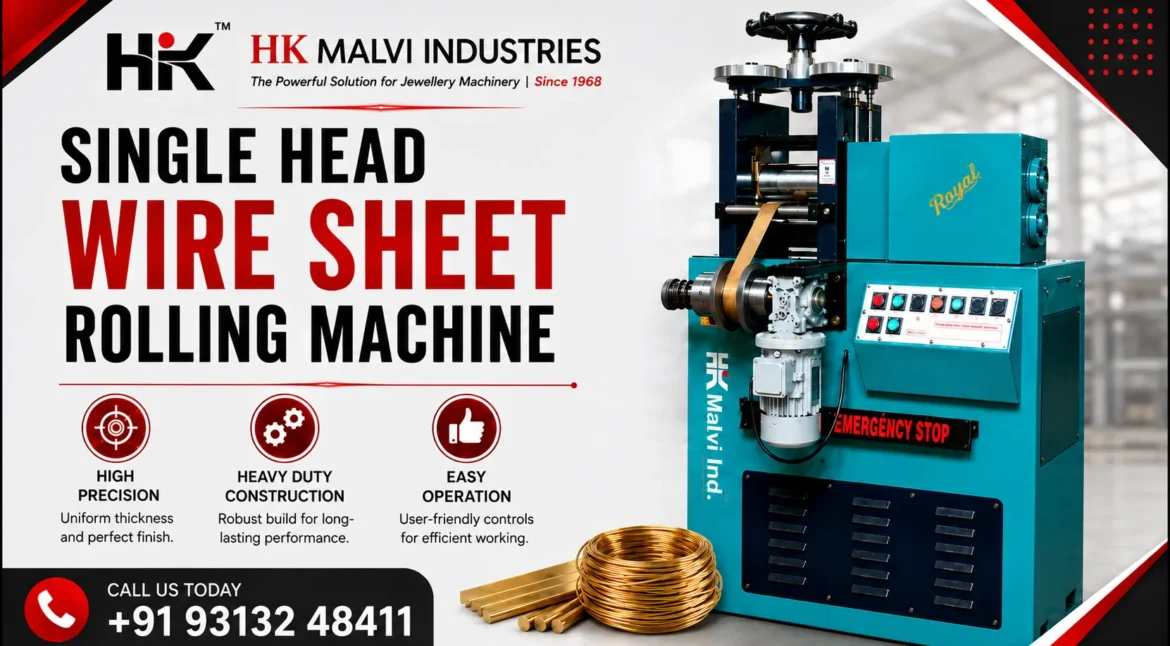
H.K Malvi Industries manufactures a range of gold rolling machines, including Single Head Gold Rolling Machine units for smaller workshops and startup jewellery brands, as well as heavier-duty options for high-volume operations. A single-head configuration works well when you’re rolling one gauge at a time and want a compact footprint — ideal for goldsmith units in Chennai or Indore that don’t have large factory floors.
For operations that need to switch between multiple thicknesses quickly, or run parallel production lines, a double-head configuration usually makes more sense. The two rollers can be set independently, which cuts down changeover time significantly — something factory owners in Hyderabad and Bangalore have told us matters a lot when they’re juggling multiple client orders in a single week.
Beyond rolling machines, the same engineering principles carry over into related equipment — wire drawing machines, gold casting machines, and full coin minting plant setups for clients building out mint operations rather than just jewellery lines. Whether it’s a single unit or a full jewellery plant setup, the fabrication tolerances stay consistent across the product range.
Navigating Quality Standards & Precision Engineering
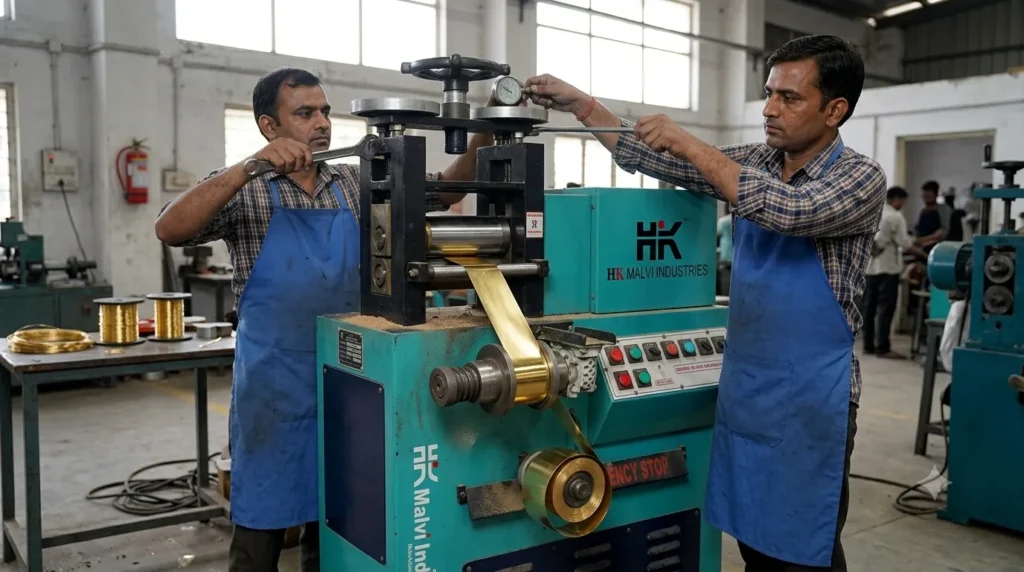
Here’s how thickness consistency actually gets achieved on a rolling machine: it comes down to roll surface hardness, bearing quality, and how rigid the frame is under load. If the frame flexes even slightly during rolling, you’ll see thickness drift across the width of the sheet — a problem that shows up later as inconsistent casting or stamping results.
Gold jewellery machinery built for the Indian market also has to account for continuous, high-duty-cycle use. A machine that’s run for eight to ten hours a day, six days a week, needs bearings and gearing rated for that kind of load — not just a design that performs well in short bursts during a demo.
Manufacturing processes at H.K Malvi Industries are aligned with ISO 9001:2015 quality management principles, and the team has built export-grade machinery for over two decades of international shipments — practical proof that the tolerances hold up under real-world, sustained use, not just in controlled test conditions.
Local Manufacturers vs H.K Malvi Industries
| Factor | Typical Local Fabricator | H.K Malvi Industries |
|---|---|---|
| Years of Manufacturing Experience | Varies, often under 10 years | 56+ years since 1968 |
| Custom Machinery Options | Limited | Extensive, 1000+ custom builds delivered |
| Export Experience | Mostly domestic-only | 20+ countries served |
| After-Sales Support | Inconsistent | Dedicated support team |
| Quality Alignment | Not always documented | ISO 9001:2015 aligned processes |
If you’re comparing jewellery machinery manufacturers in Ahmedabad or elsewhere, ask specifically about roll hardness rating, gear type, and warranty terms — these are the details that separate long-term reliability from a machine that needs frequent servicing within the first year.
Step-by-Step Process – How We Deliver Rolling Machines
- Consultation – Understanding your daily output requirement, karat range, and available floor space. This is where the Free Machinery Consultation usually starts.
- Configuration – Deciding between Top Double Head Gold Rolling Machine or single-head based on your production pattern.
- Fabrication – Precision machining of rollers, frame assembly, and motor integration.
- Testing – Running sample sheets to confirm thickness tolerance before dispatch.
- Installation & Training – On-site setup and operator training, especially important for first-time buyers setting up a new jewellery plant setup.
- After-Sales Support – Ongoing servicing and spare parts availability.
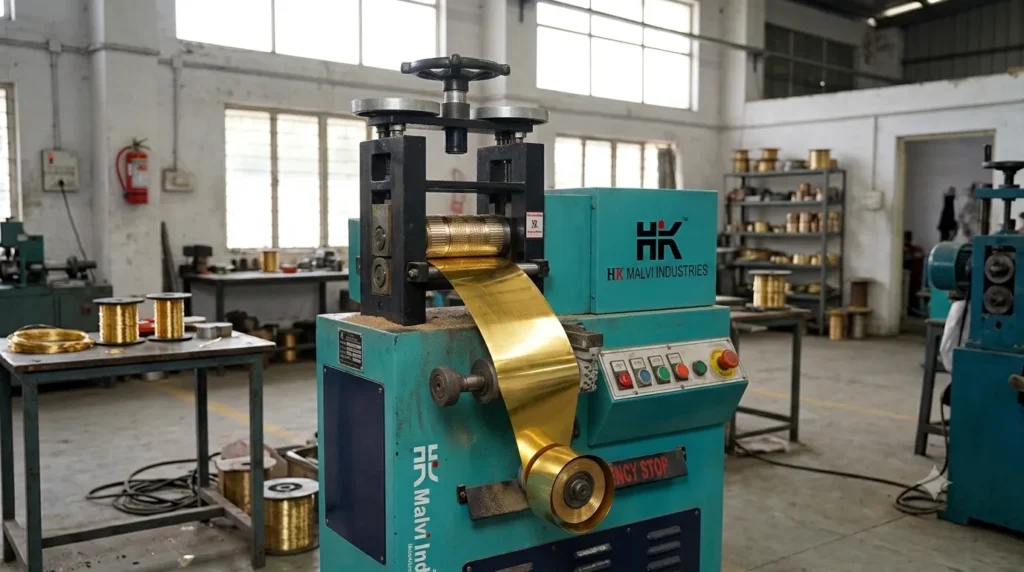
For workshops also investing in labelling and traceability, theElectric Jewellery Double Head Rolling Machineis often paired with marking systems — see our note onhow dot pin marking machines support quality control for that side of the process.
Real Client Case Study
A mid-sized jewellery manufacturing unit near Vadodara — we’ll refer to them here as “Client A” for privacy — was running an older single-roller setup. Every time they switched between 18K and 22K gold sheets, recalibration took nearly 20 minutes. That added up fast across a busy production week.
After moving to a double-head configuration with independent roll settings, changeover time dropped to roughly 5 minutes. The unit also reported fewer rejected sheets due to thickness inconsistency. This showed up clearly during their first full production cycle after installation.
This kind of outcome isn’t unusual. It happens when the roll configuration actually matches the production pattern. It’s less about the machine being “better” in the abstract. It’s more about matching equipment to how a specific workshop operates day to day.
Workshops considering an upgrade are welcome to download our Jewellery Machinery Cost Guide. It helps compare configurations before deciding. You can also reach out directly via WhatsApp for a quick technical conversation.
Founders scaling up from a jewellery machinery Ahmedabad-based workshop to multi-city supply — Pune, Kolkata, Chandigarh — often go through a similar transition. It helps to plan the machinery upgrade alongside broader factory modernisation. Our note on why jewellery factories need modern equipment covers this in more depth. And why choosing trusted jewellery machines matters is worth a read if you’re comparing vendors right now.