What Indian Jewellery Businesses Should Check Before Investing
If you are planning to expand a jewellery workshop, modernise a bullion unit, or start a new production line, the machine partner you choose will affect your output, wastage, finish quality, and long-term service cost. In practical terms, a well-built rolling, casting, pressing, or forming setup saves time every day on the shop floor. For businesses comparing Gold Jewellery Machine Manufacturers, this is where machine design, local service, and process understanding matter more than catalogue claims.
Why Choose H.K Malvi Industries for Gold Jewellery Machine Manufacturers
The real answer is experience plus engineering discipline. H.K Malvi Industries was established in 1968 and brings over 56 years of legacy in jewellery and minting machinery. The company was founded by Mr. Himmatram K. Malvi and is currently led by Mr. Shyam Malvi, CEO. That continuity matters. In Indian manufacturing, many suppliers can assemble a machine, but far fewer understand how that machine behaves after months of real production under heat, dust, operator variation, and tight delivery schedules.
For a jewellery unit in Mumbai, Surat, or Ahmedabad, the requirement may be thin sheet consistency for bangles and chains. A workshop in Jaipur may focus more on intricate casting and finishing. A bullion or token unit in Delhi or Hyderabad may need reliable pressing and coin production support. A machine builder with 1000+ custom jewellery and minting machinery solutions behind it can usually spot production issues before they become expensive.
That is one reason buyers searching for gold jewellery machinery manufacturer in Ahmedabad often look beyond price and ask deeper questions: How stable is thickness reduction? How easy is maintenance? Are spare parts available quickly? Will the supplier help with layout planning?
You can also understand the company background better through the official website, especially if you are comparing capability, product range, and service fit for your next investment.
Our Gold Jewellery Machine Manufacturers Manufacturing Capabilities
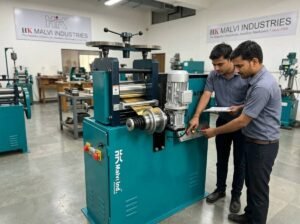
Yes, we provide a broad view of what serious buyers usually need. In this sector, machinery is rarely one-size-fits-all. Some units need a gold rolling machine for strip uniformity. Others need a wire drawing machine for chain and component production. Some require a gold casting machine integration plan, while larger projects may ask for a coin minting plant or a full jewellery plant setup.
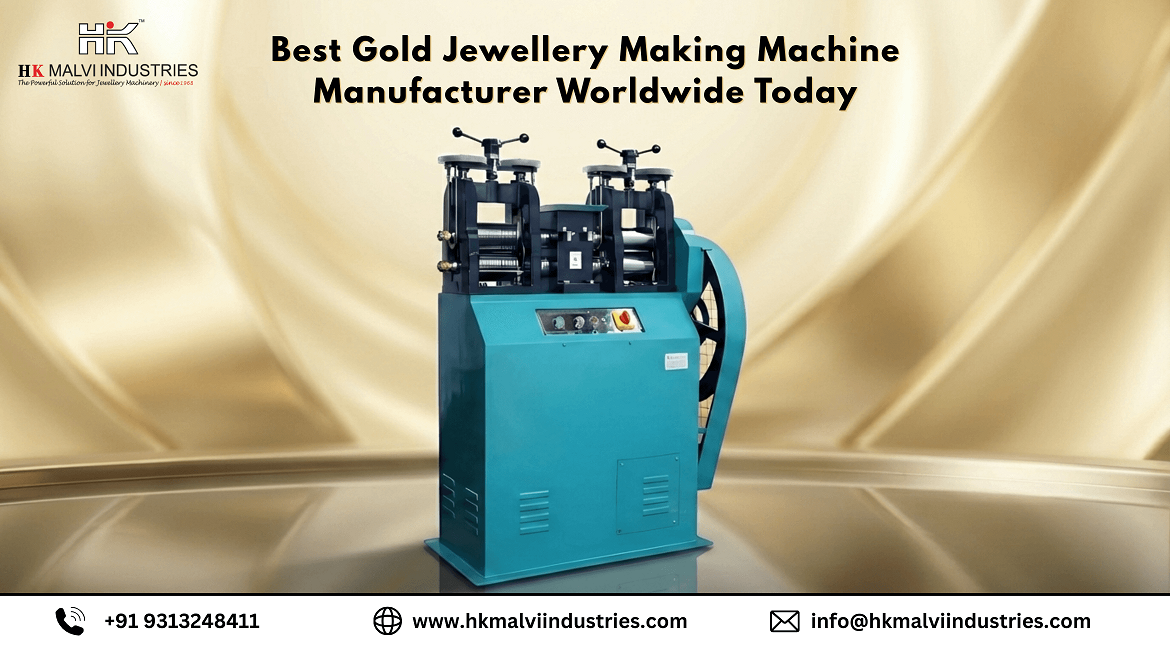
A practical production line may include rolling, drawing, hydraulic pressing, trimming, and finishing support. For example, if your workshop is scaling from manual to semi-automatic output, a double head sheet rolling machine can help improve throughput while reducing repeat passes. That matters for units handling frequent batch changes.
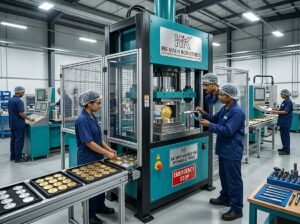
For coin and bar work, the pressing stage becomes critical. A small mismatch in die pressure or machine alignment can create recurring rejection. Businesses exploring hydraulic press machines for gold silver coins bars should assess tonnage suitability, repeat accuracy, frame stability, and after-sales support before purchase.
This is also where custom jewellery machinery India becomes a meaningful phrase, not just a keyword. Indian manufacturers often work with mixed SKUs, festival-driven demand spikes, and space constraints. A plant in Chennai may need compact placement. A customer in Bangalore may want cleaner automation and energy efficiency. A unit in Kolkata may prioritise durability because the machine runs long shifts with limited downtime windows.
A small success story illustrates the point. One workshop owner from Pune shifted from an older rolling setup to a more precise configuration after facing uneven sheet thickness and excess polishing loss. Within weeks, operator fatigue reduced, output consistency improved, and rework came down. It was not a dramatic change from the outside, but inside the workshop, it meant smoother dispatch planning and better metal control.
Navigating Quality Standards & Precision Engineering
Here’s what experienced buyers should evaluate first: frame construction, roller hardness, motor reliability, calibration stability, finish tolerance, ease of cleaning, safety systems, and service response. In jewellery machinery Ahmedabad buyers often ask whether a machine looks strong. A better question is whether it stays accurate after sustained use.
H.K Malvi Industries follows ISO 9001:2015 aligned manufacturing processes and is trusted as an exporter to 20+ countries. That gives confidence, but on the shop floor, quality shows up in simple ways: less chatter during rolling, predictable reduction, fewer alignment complaints, and better repeatability across batches.
If you want a broader industry view, the blog on why Ahmedabad leads gold jewellery machine production explains why the city has become important for precision jewellery equipment, component ecosystem support, and practical engineering know-how.
Many buyers also ask: how do I judge whether a supplier truly understands my process? The answer is by the questions they ask you. A serious manufacturer will ask about your metal type, daily production volume, target thickness, operator skill level, floor space, power conditions, and maintenance capability. That is how the right goldsmith machinery or minting machinery supplier is matched to the application.
Midway through your research, if you already know your requirement, use this:
Get a Quote for [Gold Jewellery Machine Manufacturers]
For buyers comparing regional options, another useful reference is this article on gold jewellery making machine in Ahmedabad, which helps connect machine categories to actual production needs.
Local Manufacturers vs H.K Malvi Industries (Comparison Table)
The best comparison is not local versus national in name only. It is process support versus simple supply.
|
Evaluation Point |
Typical Local Supplier |
H.K Malvi Industries |
|---|---|---|
|
Industry legacy |
Often limited or unclear |
Established in 1968 with 56+ years of legacy |
|
Leadership visibility |
Not always transparent |
Founded by Mr. Himmatram K. Malvi; led by Mr. Shyam Malvi |
|
Custom engineering |
Mostly standard models |
1000+ custom jewellery and minting machinery solutions |
|
Export readiness |
Limited |
Trusted exporter to 20+ countries |
|
Process quality |
Varies widely |
ISO 9001:2015 aligned manufacturing processes |
|
After-sales practicality |
May depend on availability |
Known for structured support and application guidance |
If you are comparing more suppliers across the country, this page on jewellery machine manufacturer in India gives a useful broader benchmark.
Step-by-Step Process – How We Deliver Gold Jewellery Machine Manufacturers
Here’s how a proper machinery project should move from enquiry to production:
Step 1: Requirement discussion
The buyer shares product type, metal, output goal, and present bottlenecks. This is where many searches for jewellery making machine manufacturers near me begin, but the right supplier should move the discussion toward technical fit, not just location.
Step 2: Application mapping
The machine maker studies whether the need is for rolling, drawing, pressing, casting, or a combined jewellery plant setup. This stage is especially important for units in Indore, Vadodara, or Chandigarh, where expansion often happens in phases.
Step 3: Machine recommendation
The supplier suggests suitable configurations, output ranges, and optional customisation. This is where buyers planning coin minting plant setup India should ask about dies, tonnage, safety, and maintenance intervals.
Step 4: Manufacturing and inspection
Precision jewellery equipment must be built, checked, and aligned before dispatch. Details like component fit, vibration control, and ease of operation matter more than glossy presentation.
Step 5: Delivery, installation, and support
The machine is shipped, installed, and operators are guided. Good support reduces startup delays and lowers the risk of early misuse.
Step 6: Ongoing optimisation
Once production starts, practical feedback from operators often leads to minor adjustments that improve output and reduce loss.
Real Client Case Study
Here’s how H.K Malvi Industries typically adds value in a real Indian context.
An anonymised client, “RJ Jewels,” from Surat, was expanding from job-work to in-house production of lightweight chains, bangles, and small minted festive tokens. Their old setup caused inconsistent strip thickness, high rework, and delayed deliveries during seasonal peaks. The owner’s first instinct was to buy multiple low-cost machines from separate vendors. On paper, that looked economical. In reality, it risked service gaps and process mismatch.
After technical discussion, the client moved ahead with a more integrated machinery plan covering rolling and press-related operations. The focus was not only on output but also on uniformity and operator ease. Within the first production cycle, the client reported better consistency, fewer repeat passes, and smoother workflow coordination between rolling and downstream finishing. Most importantly, planning became easier before Diwali demand.
This is the kind of case where a veteran supplier helps not by making loud promises, but by aligning machine capability with actual manufacturing conditions.
Frequently Asked Questions
1. What machines are usually needed in a gold jewellery production unit?
Most units need some mix of gold rolling machine, wire drawing machine, hydraulic press, casting support equipment, and finishing-related systems depending on the product line.
2. How do I choose between standard and custom machinery?
Choose standard equipment if your output is simple and stable. Choose custom machinery if you handle varied designs, mixed batch sizes, or special coin and bar applications.
3. Is Ahmedabad a good place to source jewellery machinery?
Yes. Ahmedabad has a strong manufacturing ecosystem, experienced engineering support, and practical access to jewellery machinery and service networks.
4. How important is after-sales support in this sector?
It is critical. Even a strong machine can underperform if installation, operator training, and spare support are weak.
5. Can one supplier support both jewellery and minting applications?
Yes, if the manufacturer has proven experience in both custom jewellery machinery and minting-related systems.
6. What should I ask before buying a gold rolling machine?
Ask about thickness accuracy, roller quality, reduction capacity, power needs, maintenance schedule, and support availability.
7. Where can I get consultation for machine selection?
You can request a contact consultation here and ask for a Free Machinery Consultation, WhatsApp support, or a Download Jewellery Machinery Cost Guide.