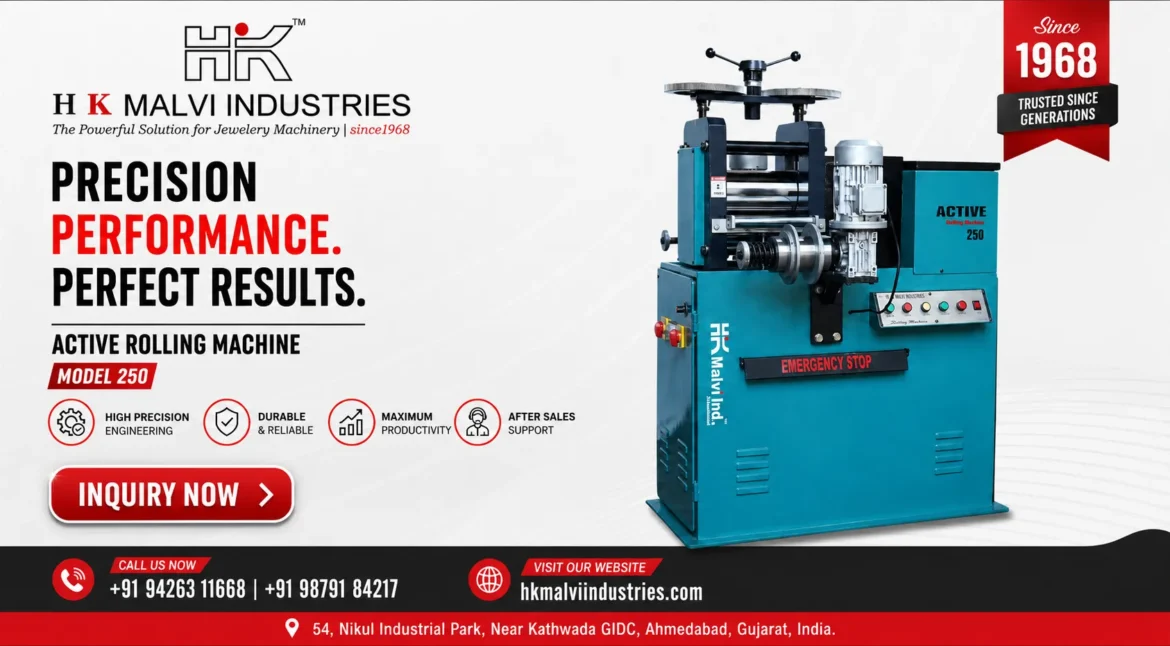
If you’ve ever stood next to a rolling mill that’s vibrating slightly off-axis, you already know what an extra 0.02mm of inconsistency costs a jewellery unit — wasted gold, rework hours, and an irritated karigar waiting on the line. Precision in a rolling machine isn’t a marketing word in this trade; it’s the difference between a clean, uniform sheet and a batch you have to melt back down. That’s the practical lens H.K Malvi Industries brings to High Precision Jewellery Rolling Machine Solutions, built from decades of shop-floor work with goldsmiths, exporters, and minting units across India.
Why Manufacturers Choose H.K Malvi Industries?
H.K Malvi Industries was founded in 1968 by Mr. Himmatram K. Malvi, and the company has stayed in the same Odhav, Ahmedabad neighbourhood since — which matters more than it sounds, because it means decades of repeat customers walking back into the same factory gate for spares, upgrades, and second machines. Today the firm is led by Mr. Shyam Malvi, who has carried forward that hands-on engineering culture rather than turning it into a purely sales-driven operation.
The best rolling machines aren’t the ones with the most features on a brochure; they’re the ones that run a full shift without a service call. That’s the standard this team builds to, whether the buyer is a single-karigar workshop in Jaipur or a mid-sized export unit in Surat. The company has supplied jewellery making machine manufacturers, goldsmiths, and minting operations across India and exported to several overseas markets, with rolling mills, wire drawing machines, and gold casting machine lines forming the backbone of most orders.
Manufacturing Capabilities for Rolling Machine Solutions
Yes, H.K Malvi Industries manufactures the full chain that surrounds a rolling operation — not just the rolling mill itself. A typical jewellery plant setup includes a sheet and wire rolling unit, a wire drawing machine for finer gauges, and often a gold casting machine or coin minting plant if the client is scaling into bars or coins. Building these as a connected line, rather than as standalone units bought from different vendors, is what keeps tolerances consistent from raw gold stock to finished sheet.
For a gold jewellery machinery manufacturer in Ahmedabad, this matters because Ahmedabad-based jewellers — and increasingly units in Vadodara and Indore — are competing with Surat’s high-volume export houses, where margins are thin and machine downtime is expensive. A rolling machine here is sized to the customer’s actual gold throughput, not a generic catalogue spec, and gear ratios, roller hardness, and motor load are adjusted to the alloy mix the client actually works with (22K, 18K, or silver).
Navigating Quality Standards & Precision Engineering
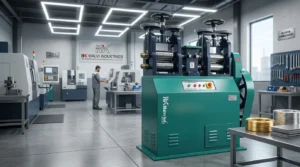
Roller alignment is where most “precision” claims fall apart in practice. A rolling mill that isn’t ground and balanced correctly will produce sheet with a barely visible wave — invisible until you try to stamp or solder it. H.K Malvi Industries‘ engineering process focuses on roller hardness matching, motor torque calibration, and frame rigidity testing before a machine leaves the floor, since these three factors account for most of the rejection issues karigars complain about with cheaper imports.
This is also where custom jewellery machinery India orders differ from off-the-shelf units. A Chennai-based bangle manufacturer and a Kolkata-based chain unit don’t need the same roller width or feed speed, and treating every order as identical is how manufacturers end up with machines that “almost” fit the job.
Local Manufacturers vs H.K Malvi Industries
| Factor | Typical Local Workshop | H.K Malvi Industries |
|---|---|---|
| Customisation | Limited, mostly fixed sizes | Built around alloy type and throughput |
| After-sales support | Often informal, slow response | Structured service and spares access |
| Export documentation | Rarely handled in-house | Experience shipping overseas |
| Engineering legacy | Varies widely | Family-run since 1968 |
Step-by-Step Process: How a Rolling Machine Order Is Delivered
Here’s how H.K Malvi Industries typically handles a rolling machine order. First, the team discusses your gold or silver throughput, alloy type, and existing workshop layout — a goldsmith in Pune working solo has very different needs than a 40-worker unit in Hyderabad. Second, roller width, motor power, and frame design are finalised based on that conversation, not a fixed catalogue size. Third, the machine is fabricated and tested under load in-house before dispatch, which is the stage where most quality issues would otherwise surface after delivery rather than before. Finally, installation guidance and after-sales support are provided, since a rolling mill that’s improperly mounted on an uneven floor will develop alignment problems within months regardless of how well it was built.
A Real Client Example
One illustrative case: a mid-sized jewellery manufacturing unit expanding from handmade chains into machine-rolled sheet work approached H.K Malvi Industries after struggling with an imported rolling mill that kept drifting out of calibration every few weeks. The replacement unit was sized to their actual 22K gold volume rather than a generic spec, with roller hardness matched to their alloy mix. Within the first few months of use, the unit reported fewer rejected sheets and noticeably less time lost to recalibration — a fairly common outcome when a machine is built around real throughput numbers instead of a one-size-fits-all design.
Faqs
1. What is a high precision jewellery rolling machine used for?
- A high precision jewellery rolling machine is used to reduce metal thickness, create uniform sheets, and produce accurate wires for gold, silver, platinum, and other precious metal jewellery manufacturing.
2. Why is precision important in jewellery rolling machines?
- Precision ensures consistent thickness, minimizes metal wastage, improves surface finish quality, and helps jewellers achieve accurate results during production.
3. Which metals can be processed with a jewellery rolling machine?
- Most jewellery rolling machines can process gold, silver, platinum, copper, brass, and other non-ferrous metals used in jewellery making.
4. Jewellery rolling machine se metal wastage kaise kam hota hai?
- High precision rollers metal ko uniform thickness me process karte hain, jisse uneven rolling aur material loss kam hota hai aur production efficiency badhti hai.
5. Kya rolling machine small jewellery workshops ke liye suitable hai?
- Haan, modern jewellery rolling machines small workshops se lekar large manufacturing units tak ke liye suitable hoti hain aur productivity improve karti hain.
6. Gold aur silver rolling ke liye kaunsi machine best rahegi?
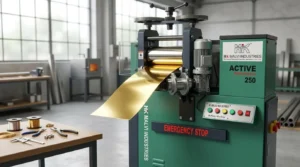
- High precision active rolling machines gold aur silver rolling ke liye ideal hoti hain kyunki ye accurate thickness control aur smooth finishing provide karti hain.
7. How does a jewellery rolling machine improve production efficiency?
- It automates the rolling process, reduces manual effort, maintains dimensional accuracy, speeds up production, and delivers consistent quality output for jewellery manufacturers.