What Is a Double Head Sheet Rolling Machine?
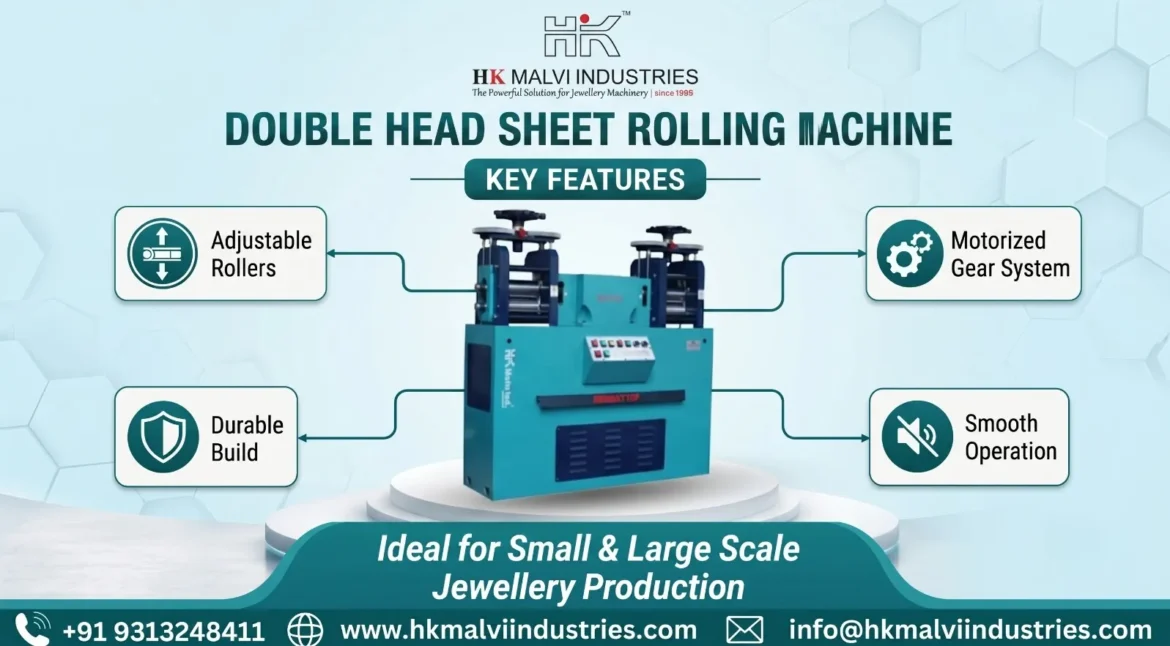
A Double Head Sheet Rolling Machine is an advanced jewellery manufacturing machine designed to produce uniform metal sheets with high precision and consistency. If you’re wondering How Does Double Head Sheet Rolling Machine Work, it uses dual rolling heads to apply controlled pressure for smooth, accurate thickness. HK Malvi Industries manufactures reliable machines that improve productivity, reduce material waste, and deliver consistent rolling performance for jewellery production.
How Does a Double Head Sheet Rolling Machine Work? A Practical Guide for Jewellery Manufacturers
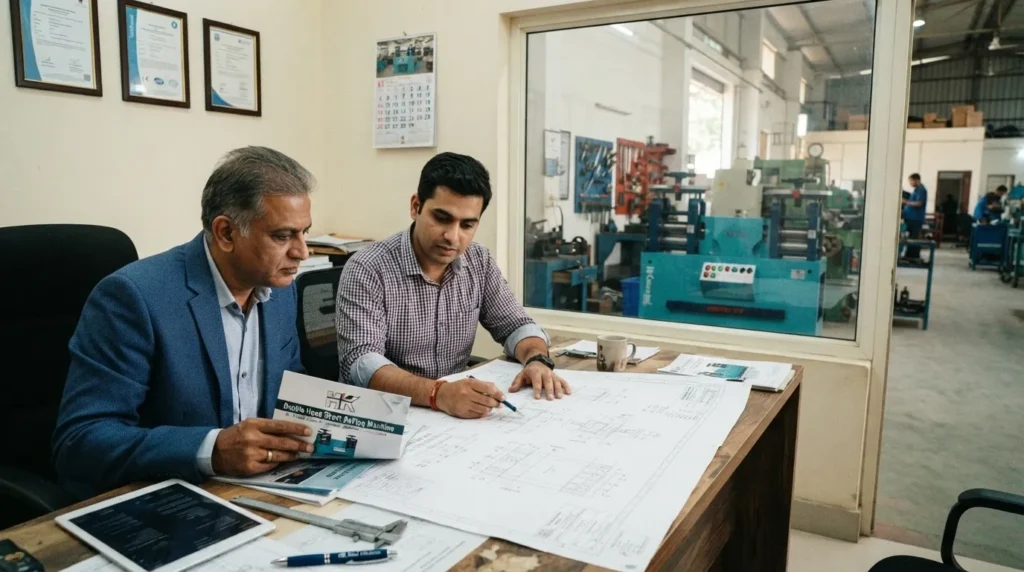
For jewellery manufacturers deciding between manual rolling and automated systems, understanding the mechanics of a double head sheet rolling machine can save both metal wastage and production time. This equipment sits at the core of gold and silver sheet preparation, and getting the rolling process right directly affects everything downstream — from stamping to casting to finishing. Here’s a practical breakdown of how it actually works, and what to look for when sourcing one.
Why Choose H.K Malvi Industries for Double Head Sheet Rolling Machines
H.K Malvi Industries, operating from Odhav, Ahmedabad since 1968, brings over 56 years of hands-on engineering experience to precision jewellery machinery manufacturing. Founded by Mr. Himmatram K. Malvi and currently led by Mr. Shyam Malvi as CEO, the company has delivered 1000+ custom jewellery and minting machinery solutions across India and to 20+ export markets.
For goldsmiths and jewellery manufacturers evaluating jewellery making machine manufacturers, longevity in this business usually says something — rolling mills, in particular, are equipment you expect to run for a decade or more without major issues. H.K Malvi Industries’ manufacturing follows ISO 9001:2015 aligned processes, which matters when you’re investing in machinery that needs to hold tight tolerances year after year.
Here’s how H.K Malvi Industries approaches double head sheet rolling machines: each unit is built around dual rolling heads that allow simultaneous or sequential reduction passes, cutting down the number of manual re-feeds a single-head machine would require.
Double Head Sheet Rolling Machine: Manufacturing Capabilities
A double head sheet rolling machine works by passing a cast gold or silver ingot between two sets of precision-ground rollers, mounted on separate heads, to progressively reduce thickness while maintaining uniform width and surface finish. The dual-head configuration means an operator can set different roller gaps on each head — one for coarse reduction, one for fine finishing — without having to manually readjust settings between passes.
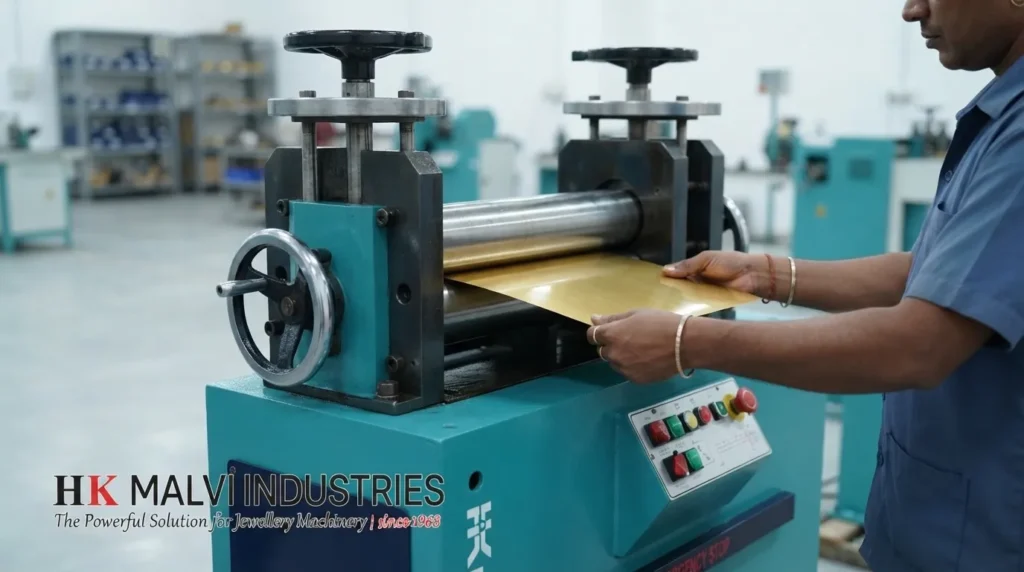
In practice, this matters most for gold jewellery machinery buyers who process high volumes. A single-head rolling mill requires stopping, adjusting the gap, and re-feeding the sheet multiple times to reach final thickness. With a double head setup, the metal moves through both stages more continuously, which reduces handling time and, importantly, reduces the risk of surface scratching from repeated manual feeding.
The machines also integrate with related equipment in a typical jewellery plant setup — including gold rolling machine units for wire stock preparation, wire drawing machine systems, and gold casting machine lines. Many manufacturers in Ahmedabad’s jewellery cluster prefer sourcing these as a coordinated set rather than piecing together equipment from different vendors, since roller specifications and motor synchronization need to match across the line.
Navigating Quality Standards and Precision Engineering
Precision in sheet rolling comes down to roller hardness, gap consistency, and motor calibration — get any one of these wrong, and you end up with sheets that vary in thickness across their length, which creates problems later during stamping or die-cutting. As a result, jewellery manufacturers often specify tolerance requirements upfront when ordering equipment, particularly for coin and medallion work where thickness uniformity affects weight consistency.
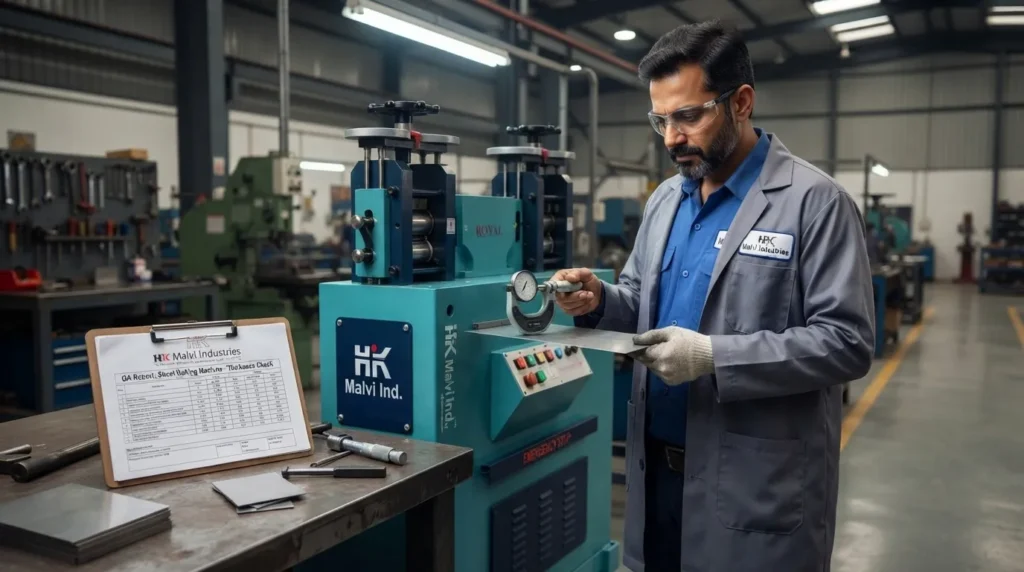
For precision jewellery equipment used in coin minting plant applications, this tolerance discipline becomes even more critical, since minting authorities and private mints typically work to strict weight specifications per unit. A machinery supplier’s ability to hold roller calibration across thousands of production cycles, therefore, becomes a genuine differentiator rather than a marketing claim.
H.K Malvi Industries manufactures under ISO 9001:2015 aligned processes, and the engineering team calibrates roller assemblies to reduce the drift that typically occurs with lower-grade bearing systems over extended use. In addition, energy-efficient motor design keeps running costs manageable for manufacturers operating multiple shifts, which is common in busy production hubs like Mumbai, Surat, and Jaipur.
Local Manufacturers vs H.K Malvi Industries: A Comparison
Jewellery manufacturers across Delhi, Chennai, and Kolkata frequently compare regional fabricators against established machinery manufacturers before making a purchase decision. Here’s how the two typically differ:
| Factor | Local Fabricators | H.K Malvi Industries |
|---|---|---|
| Engineering Legacy | Typically newer operations | 56+ years, established since 1968 |
| Customization Capability | Limited to standard models | Custom jewellery machinery India-wide |
| Quality Standards | Varies by workshop | ISO 9001:2015 aligned manufacturing |
| Export Experience | Mostly domestic focus | Exporter to 20+ countries |
| Track Record | Case-by-case | 1000+ machines delivered |
| After-Sales Support | Often limited | Dedicated support and WhatsApp access |
Step-by-Step Process: How H.K Malvi Industries Delivers Double Head Sheet Rolling Machines
Understanding the actual delivery process helps buyers set realistic expectations rather than relying on a sales pitch alone.
1. Requirement Discussion — Manufacturers share their sheet width, thickness range, and daily output targets via phone, WhatsApp, or the contact form, since roller sizing depends heavily on these specifications.
2. Custom Configuration — Based on the requirement, the engineering team recommends roller diameter, motor capacity, and head configuration, often alongside a Download Jewellery Machinery Cost Guide for buyers comparing multiple suppliers.
3. Manufacturing and Calibration — Once specifications are confirmed, the machine moves into fabrication, with roller assemblies calibrated and tested for gap consistency before dispatch.
4. Factory Testing — Before shipping, each unit runs test passes with sample sheet stock to verify thickness uniformity across the roller width.
5. Dispatch and Installation Support — Machines are shipped to destinations across India, including Vadodara, Indore, and Chandigarh, with installation guidance provided remotely or on-site depending on order scale.
6. After-Sales Support — Ongoing support covers roller maintenance, part replacement, and troubleshooting for manufacturers running multi-shift operations.
Real Client Case Study
A jewellery manufacturing unit in Rajkot, producing gold chains and bangles for wholesale distribution across Gujarat, had been running a single-head rolling mill that required frequent manual gap adjustments throughout the day. Their production supervisor estimated significant time lost daily just on re-feeding and readjustment between coarse and fine passes. After switching to a double head sheet rolling machine from H.K Malvi Industries, the unit reported a smoother production flow, with coarse and fine rolling stages running without the repeated manual intervention their previous setup demanded. This kind of operational bottleneck is common among manufacturers still relying on older single-head equipment, particularly as order volumes grow.