Why Leading Jewellers Choose Precision Rolling Machine for Their Gold Manufacturing Setup
Walk into any serious jewellery manufacturing unit in Surat, Jaipur, or Hyderabad and ask the senior goldsmith what keeps their production quality consistent day after day — almost every one of them will point to their rolling machine. A good gold rolling machine is not just another piece of equipment; it is the heartbeat of your entire sheet and wire production line. When the rolls are not precise, the sheet thickness is uneven, the wire gauge goes off, wastage climbs, and the whole batch has to be redone. For jewellery businesses where gold rates are volatile and every milligram counts, that kind of rework is simply not affordable.
This is exactly why jewellery manufacturers — from small goldsmith workshops in Indore and Chandigarh to large minting and casting facilities in Mumbai and Delhi — increasingly look for precision-engineered rolling solutions rather than just “any machine that rolls metal.” Over the past few years, there has been a clear shift: buyers are asking smarter questions about roller hardness, gear ratio, motor efficiency, and after-sales support before signing any purchase order.
H.K Malvi Industries, based in Odhav, Ahmedabad, has been at the centre of this precision manufacturing conversation for over five and a half decades. Founded in 1968 by Mr. Himmatram K. Malvi and now led by Mr. Shyam Malvi, the company has built and delivered 1000+ custom jewellery machinery solutions to clients across India and 20+ countries. This article walks through the real reasons why leading jewellers choose precision rolling machines, what to look for when you are evaluating one, and how the right machinery partner makes all the difference.
Why Choose H.K Malvi Industries for Precision Rolling Machine Solutions?
The Indian jewellery machinery market has no shortage of options. You will find rolling machines at every price point — from basic workshop-grade models to fully automated CNC-controlled lines. So why do jewellery manufacturers from Kolkata’s Bowbazar district to the gold bazaars of Chennai keep returning to H.K Malvi Industries?
The answer is not just about price or availability. It is about engineering reliability over decades. When a machine is designed to handle high-purity gold alloys without microfractures in the sheet, it needs rollers ground to tolerances that budget machines simply cannot match. The company’s manufacturing team in Ahmedabad uses hardened alloy steel rolls, precision-ground by CNC machines, with surface hardness levels tested before every dispatch. This is the kind of detail that rarely appears in a product brochure but is deeply felt on the shop floor.
A goldsmith from Pune who had been using a generic machine for years once shared how his rejection rate on 22-karat bangles dropped from nearly 8% to under 2% after switching to a precision unit. That 6% difference, multiplied across daily gold volumes, translated to lakhs of rupees saved annually. The machine paid for itself within months. This is the real calculus that serious jewellery business owners understand.
For those specifically searching for jewellery making machine manufacturers near me or considering setting up a new production unit, the right first step is a machinery consultation with engineers who understand your production mix — not just a generic catalogue request.
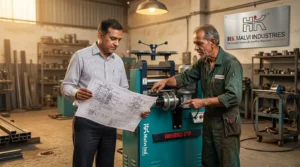
Our Precision Rolling Machine Manufacturing Capabilities
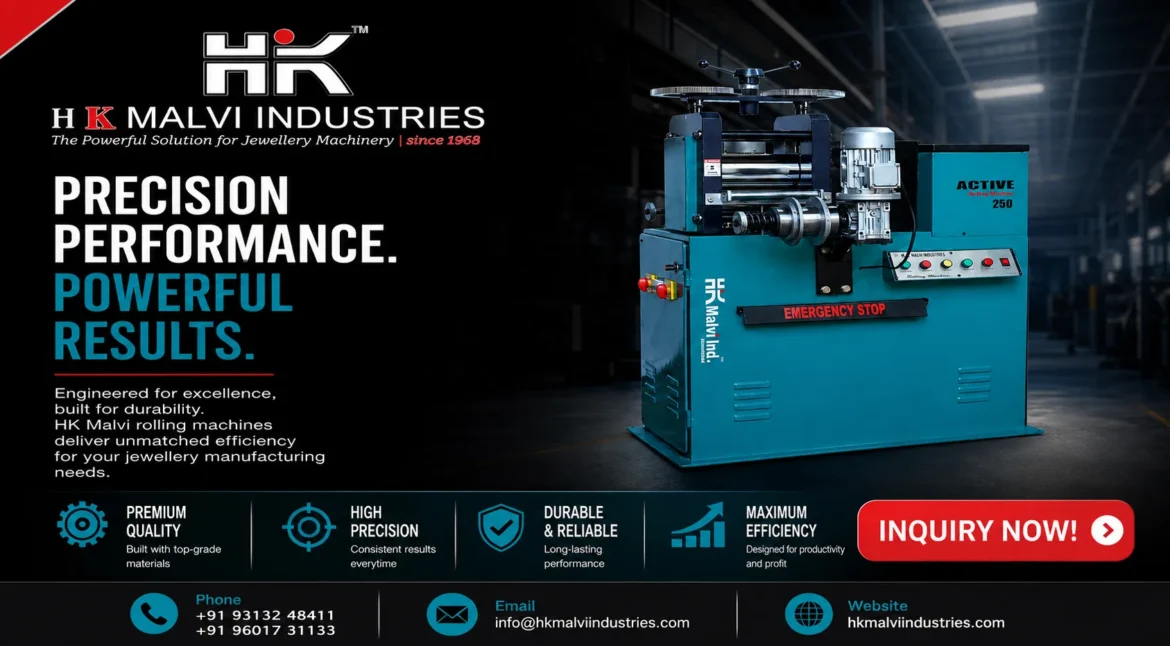
H.K Malvi Industries manufactures rolling machines across several configurations, each designed for a specific production requirement. The core product range covers flat rolling mills for sheet production, combination rolling mills (flat + wire grooves), and heavy-duty industrial rolling lines for minting plants and bullion refineries.
Key engineering features across the product range:
- Roller diameter and length options from 60mm to 250mm to accommodate varying production capacities
- Motorised top roller adjustment for consistent gap control — critical when switching between different karat alloys or metals
- Gear-driven roller systems with hardened and ground gear sets for smooth torque transmission
- Variable speed control for motor-driven models — slowing down for thicker stock, speeding up for thin finishing passes
- Anti-backlash mechanisms in the drive train to prevent sheet surface marks
- Custom groove configurations for wire drawing applications integrated with the same unit
For jewellery businesses setting up a jewellery plant setup from scratch — say, a new manufacturing unit in Vadodara or Bangalore — the company offers complete plant layout consultation as part of the machinery package. This means the rolling mill, wire drawing machine, gold casting machine, and finishing equipment are all planned together for optimal workflow, not just sold as individual pieces.
Minting operations have their own requirements. A coin minting plant setup needs rolling mills that can produce extremely uniform metal blanks with tight thickness tolerances — sometimes within ±0.01mm. This is a completely different engineering challenge compared to jewellery sheet rolling, and it is one where the company’s five-decade experience with diverse manufacturing requirements genuinely shows in the product design.
Navigating Quality Standards and Precision Engineering in Rolling Machines
One question that comes up often from jewellery manufacturers in Jaipur and Mumbai — especially those who have had bad experiences with substandard machines — is: how do you actually verify the quality of a rolling machine before you buy it?
There are a few practical checkpoints that experienced buyers use:
Roller Surface Finish and Hardness: The rolling surface should have a mirror polish with hardness in the range of 58–65 HRC (Rockwell C scale) for jewellery applications. Softer rollers wear faster, pick up marks from the metal, and transfer those marks onto your gold sheet. Ask the manufacturer to share hardness test certificates for the rollers — any serious gold jewellery machinery manufacturer will have this data readily available.
Frame Rigidity: Rolling mills for gold and silver alloys work under significant lateral pressure. If the machine frame has even slight flexing, the gap between rollers changes under load, creating thickness variation across the sheet width. Cast iron or fabricated steel frames with sufficient section thickness and properly machined bearing housings are non-negotiable for precision work.
Bearing Quality and Lubrication: Good rolling mills use heavy-duty taper roller bearings or spherical roller bearings, not cheap ball bearings. The lubrication system — whether grease-packed or oil-bath — directly affects bearing life and roller alignment over time. This is an area where manufacturing quality genuinely separates reliable precision jewellery equipment from commodity machines.
For goldsmith machinery operating in workshop environments across cities like Hyderabad and Indore, energy efficiency is also increasingly important as power costs rise. Variable frequency drives (VFDs) on motorised rolling mills can reduce energy consumption significantly during lighter rolling passes — a small investment that pays back over time.
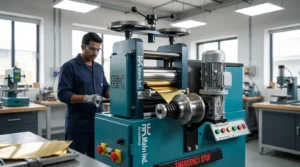
Local Manufacturers vs H.K Malvi Industries — Comparison Table
Here is a practical comparison to help you evaluate your options when sourcing jewellery machinery Ahmedabad or from other production hubs:
| Parameter | Typical Local Manufacturer | H.K Malvi Industries |
|---|---|---|
| Years of Experience | 2–10 years (most) | 56+ years (since 1968) |
| Roller Hardness Certification | Rarely provided | Documented, available on request |
| Custom Configuration | Limited or no customisation | Full custom — size, groove pattern, motor, drive |
| Machines Delivered | Typically under 200 | 1000+ across India and 20+ countries |
| Export Track Record | Mostly domestic only | Active exports to 20+ countries |
| After-Sales Support | Varies widely; often poor | Dedicated post-installation support team |
| Plant Layout Consultation | Not offered | Included for full plant setups |
| Minting Plant Capability | Not available in most cases | Specialised coin minting plant machinery available |
| ISO-Aligned Manufacturing | Rarely certified | ISO 9001:2015 aligned processes |
| Energy-Efficient Design Options | Not a standard offering | Available with VFD and energy-efficient motors |
Step-by-Step Process — How We Deliver Your Precision Rolling Machine
For buyers unfamiliar with how a machinery order actually flows — from first conversation to machine running on your shop floor — here is a straightforward walkthrough of how H.K Malvi Industries handles the process:
- Initial Consultation: A technical discussion (phone, WhatsApp, or in-person at our Odhav, Ahmedabad facility) to understand your production requirements — metals you process, desired output volumes, existing machinery, space availability, and power supply.
- Specification Finalization: Based on the consultation, the engineering team prepares a detailed machine specification document. For custom jewellery machinery India orders, this may include custom roller grooves, special frame sizes, or integration with existing lines.
- Quotation and Order Confirmation: A clear, itemized quotation with delivery timelines. No hidden charges, no vague “as applicable” entries.
- Manufacturing: Production begins at our GIDC Industrial Area workshop. For standard models, lead times are shorter. Custom configurations take additional time depending on complexity.
- Quality Inspection: Every machine goes through a pre-dispatch inspection — roller hardness check, no-load running test, dimensional verification, and surface finish inspection.
- Dispatch and Installation: Safe packaging for transport across India and for export. Installation support is available on-site or via guided remote assistance for clients in cities like Chennai, Kolkata, Bangalore, and beyond.
- After-Sales Support: Spare parts availability, operational guidance, and technical assistance — available throughout the machine’s service life.
Real Client Case Study — Jewellery Manufacturer, Jaipur
Client: Anonymised as “Rajputana Gold Craft” — Jaipur, Rajasthan
Background: A second-generation jewellery manufacturing unit in Jaipur producing 22-karat gold bangles, chains, and kadas for wholesale distribution across Delhi, Mumbai, and Surat. Daily gold processing volume was approximately 1.5 kg, with plans to scale to 3 kg within 18 months.
Problem: Their existing rolling mill, purchased from a local fabricator six years prior, was producing inconsistent sheet thickness — varying by up to ±0.08mm across the same sheet width. This was causing wastage during stamping and die-pressing operations. Additionally, the machine was consuming significantly more power than expected due to an oversized motor running inefficiently at partial loads.
Solution Provided: After a detailed consultation and a review of their production mix, the team at H.K Malvi Industries supplied a combination rolling mill with CNC-ground hardened rollers, anti-deflection frame reinforcement, and a correctly sized motor with VFD control. The roller groove configuration was customised to accommodate both their sheet rolling and light wire production requirements.
Results After 6 Months:
- Thickness variation reduced to ±0.015mm — well within their quality requirement
- Sheet wastage in downstream stamping operations dropped by approximately 60%
- Monthly electricity bill for the rolling mill section reduced by nearly 22%
- Production capacity increased as the new machine allowed faster rolling passes without quality compromise
Client Feedback (paraphrased): “The difference was visible from the first batch itself. The sheet surface was clean, thickness was uniform, and the machine ran without vibration or noise. It changed how our stamping team operated — they stopped having to re-adjust the press settings every few batches.”
Mini Success — Minting Plant, Vadodara
A minting machinery supplier partner in Vadodara approached H.K Malvi Industries for a rolling line upgrade for their coin blank production. The requirement was extreme: thickness tolerance of ±0.008mm on 25mm diameter brass and cupronickel blanks. The supplied heavy-duty rolling mill with precision roller grinding and automated gap control met this specification in production testing. The client has since placed a repeat order for a second line.
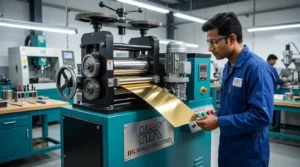
Frequently Asked Questions — Precision Rolling Machine for Jewellery Manufacturing
1. Why do leading jewellers prefer precision rolling machines?
- Leading jewellers prefer precision rolling machines because they ensure uniform thickness, superior surface finish, reduced metal wastage, and consistent jewellery quality across every production batch.
2. How does a precision rolling machine improve jewellery manufacturing efficiency?
- A precision rolling machine streamlines metal forming processes, reduces manual adjustments, increases production speed, and helps manufacturers maintain high-quality standards with minimal downtime.
3. What are the key benefits of using precision rolling machines for gold and silver jewellery?
- The main benefits include accurate thickness control, improved material utilization, enhanced product consistency, lower production costs, and better finishing quality for gold and silver jewellery.
4. Jewellery rolling machine me precision itni important kyu hoti hai?
- Precision se gold aur silver sheets ki thickness uniform rehti hai, material wastage kam hota hai aur final jewellery ki quality aur finishing significantly improve hoti hai.
5. Kya precision rolling machine se production speed badh sakti hai?
- Haan, precision rolling machines faster processing, consistent output aur kam rework ke through jewellery manufacturing productivity ko kaafi improve karti hain.
6. Which features should jewellers consider before buying a precision rolling machine?
- Jewellers should evaluate roller quality, thickness accuracy, machine durability, automation capabilities, maintenance requirements, and after-sales support before investing.
7. Top jewellers HK Malvi Industries ki rolling machines par bharosa kyu karte hain?
- HK Malvi Industries ki rolling machines high precision, robust construction, reliable performance aur long-term durability provide karti hain, jo professional jewellery manufacturers ki requirements ko effectively support karti hain.