HK Malvi Industries – Trusted Jewellery Machinery Manufacturer Since 1968
If you’ve ever stood on a jewellery shop floor watching a batch of gold sheets come out uneven, too thin in patches or thick in others, you already know how much that single flaw can cost a manufacturer. A precision rolling machine isn’t just another piece of equipment in a jewellery unit — it’s the difference between consistent, sellable output and a pile of rework that eats into your margins every single month. For goldsmiths, mid-sized manufacturing units, and even large minting operations across India, getting the rolling stage right sets the tone for everything that follows: stamping, casting, wire drawing, and final finishing.
Why Choose H.K Malvi Industries for Boost Jewellery Production With Precision Rolling Machine?
H.K Malvi Industries has been working with metal — gold, silver, and alloy — since 1968. That’s 56+ years of watching the jewellery manufacturing sector change, from manual hammering setups to today’s motor-driven, micron-accurate rolling systems. The company is currently led by Mr. Shyam Malvi, who took over the engineering vision originally set by founder Mr. Himmatram K. Malvi.
Here’s how H.K Malvi Industries approaches a rolling machine order: it starts with understanding your daily output target, not just handing over a catalogue. A goldsmith in Jaipur processing 2–3 kg of gold a day has very different needs than a minting unit in Ahmedabad running continuous shifts. Over the years, the team has delivered 1000+ custom jewellery and minting machinery solutions, and that pattern recognition — knowing which roller gap settings suit thin chain-making versus thick bangle work — comes only from doing this for decades, not from a brochure.
Export clients across 20+ countries have also pushed the engineering standards higher, since machinery shipped abroad has to survive different power conditions, humidity levels, and operator skill levels without constant servicing support nearby.
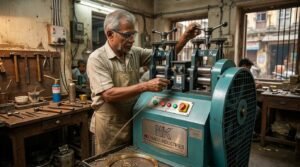
Our Boost Jewellery Production With Precision Rolling Machine Manufacturing Capabilities
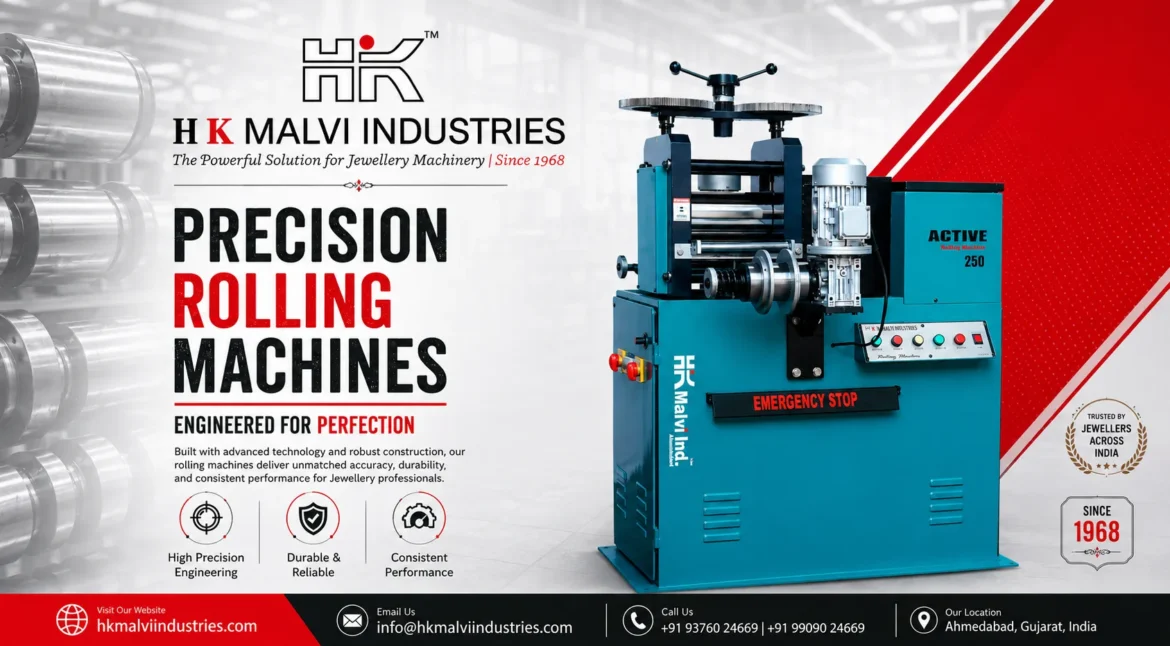
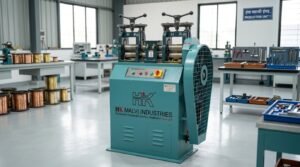
The gold rolling machine range at H.K Malvi Industries is built around one core idea: repeatability. A roller that gives you 0.2mm sheet thickness today and 0.23mm tomorrow isn’t precision — it’s guesswork with extra steps. The manufacturing line includes flat rolling machines, wire rolling units, and combination rollers for workshops that don’t have floor space for separate machines.
Most units coming out of the Odhav, Ahmedabad facility are built with hardened steel rollers, adjustable gap control, and motor configurations ranging from half-horsepower setups (suited to small goldsmith units) up to heavier-duty motors for coin minting plant operations that need to roll thicker stock continuously.
Alongside rolling machines, the broader jewellery machinery Ahmedabad product line covers wire drawing machines, gold casting machines, and finishing equipment — so a manufacturer in Surat or Mumbai setting up a new line doesn’t need to coordinate between five different vendors for five different machines.
Navigating Quality Standards & Precision Engineering
A common question from new clients, especially first-time jewellery brand owners in Bangalore or Hyderabad, is how to actually judge machine quality before buying. The honest answer: check the roller hardness, check gap consistency under load (not just when idle), and ask for a live demo with your own metal stock if possible.
H.K Malvi Industries follows manufacturing processes aligned with ISO 9001:2015 quality principles, and every rolling machine goes through load testing before dispatch. This matters more than it sounds — a roller that performs well for five minutes in a showroom demo can behave very differently after eight hours of continuous factory use. Precision jewellery equipment has to hold its tolerance across long shifts, not just short bursts.
For startups and smaller goldsmith units in Indore or Vadodara, the team also explains realistic maintenance schedules upfront, since a rolling machine bought without a service plan often turns into a costly liability within two to three years.
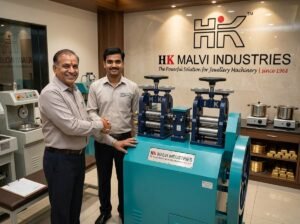
Local Manufacturers vs H.K Malvi Industries
| Parameter | Typical Local Manufacturer | H.K Malvi Industries |
|---|---|---|
| Years of Manufacturing Experience | Varies, often under 10 years | 56+ years (since 1968) |
| Customisation for Coin Minting | Limited or outsourced | In-house engineering team |
| Export Experience | Mostly domestic-only | 20+ countries served |
| After-Sales Support | Inconsistent | Dedicated service follow-up |
| Machines Delivered | Not publicly tracked | 1000+ custom installations |
This isn’t to say every local workshop turning out rollers is unreliable — many are honest, hardworking setups. But for manufacturers planning to scale, especially those eyeing a jewellery plant setup with multiple machine types working together, track record and documented after-sales support tend to matter more once the initial purchase excitement wears off.
Step-by-Step Process – How We Deliver Boost Jewellery Production With Precision Rolling Machine?
The process usually starts with a phone or WhatsApp conversation, not a sales pitch. A client from Chennai recently called asking for a rolling machine but, after a quick discussion about his daily output and metal types, it became clear he also needed a complementary wire drawing setup. That kind of clarification happens before any quotation is shared.
Once requirements are confirmed, the engineering team finalises roller specifications — width, motor capacity, gap tolerance — based on the client’s actual production volume rather than a one-size-fits-all model. Manufacturing at the Odhav, Ahmedabad unit typically takes a few weeks depending on customisation level, followed by load testing. For custom jewellery machinery India orders involving multiple units (rolling plus casting plus finishing), staggered delivery is often arranged so the client’s team can train on one machine before the next arrives.
Installation support and basic operator training are part of the standard process, and the after-sales team stays reachable for troubleshooting calls — something that matters a lot for goldsmiths in smaller towns who don’t have easy access to technicians.
Real Client Case Study
A mid-sized jewellery manufacturing unit based in Pune, run by a second-generation goldsmith family, had been outsourcing their sheet rolling to a job-work vendor for years. The arrangement worked when order volumes were low, but as their retail tie-ups grew, waiting two to three days for rolled sheets started delaying entire production batches.
After consulting with H.K Malvi Industries, the family invested in an in-house gold rolling machine sized for their actual daily volume rather than an oversized industrial unit they didn’t need. Within the first few months, turnaround time for rolled sheets dropped from days to hours, since the work no longer left the premises. The owner later mentioned that the biggest unexpected benefit wasn’t speed — it was quality consistency, since they could now adjust roller settings themselves for different jewellery lines instead of depending on a vendor’s general-purpose output.
FAQs – Boost Jewellery Production With Precision Rolling Machine
1. What is a precision rolling machine used for in jewellery manufacturing?
- A precision rolling machine is designed to reduce the thickness of gold, silver, platinum, and other precious metals while maintaining uniform dimensions. It helps jewellers produce high-quality sheets, strips, and wires with minimal material loss and consistent accuracy.
2. How does a precision rolling machine improve jewellery production efficiency?
- By delivering accurate thickness control, smooth roller performance, and faster processing, a precision rolling machine reduces manual rework, minimizes metal wastage, improves productivity, and ensures consistent product quality across every production batch.
3. Which industries benefit from precision rolling machines?
- Precision rolling machines are widely used in jewellery manufacturing, precious metal processing, coin minting, bullion production, jewellery casting units, artisan workshops, and industrial metal fabrication where high dimensional accuracy is essential.
4. Precision Rolling Machine lene se production kitna improve hota hai?
- Ek high-quality precision rolling machine production speed ko significantly improve karti hai. Uniform rolling, kam metal wastage, aur less manual finishing ki wajah se manufacturers kam time me zyada consistent jewellery components bana sakte hain.
5. Gold aur Silver ke liye kaunsi rolling machine best rahegi?
- Agar aap gold ya silver jewellery manufacture karte hain, to hardened rollers, accurate thickness adjustment, durable gearbox, aur stable motor wali precision rolling machine sabse best choice hoti hai. Isse premium finish aur repeatable results milte hain.
6. Jewellery workshop ke liye precision rolling machine kyun important hai?
- Kyunki jewellery manufacturing me har micron matter karta hai. Precision rolling machine accurate thickness maintain karti hai, material loss kam karti hai, production ko fast banati hai aur final jewellery ki finishing ko improve karti hai.
7. What features should you consider before buying a precision rolling machine?
- Look for hardened alloy steel rollers, precision thickness adjustment, heavy-duty construction, reliable motor performance, low maintenance requirements, energy efficiency, safety features, and strong after-sales support to ensure long-term productivity and consistent manufacturing quality.